Wednesday, December 14, 2022

From Stuart Dempster to Dave's Basement 1981-1982

your blogger with employment worthy haircut ca. 1981
During my last quarter at the UW I was a member of the University of Washington Contemporary Group Improvisation Ensemble, led that quarter by Seattle's legendary musical provacateur Stuart Dempster. I had been improvising on my own for years by then as part of my piano studies and later on of my compositional process, so I was comfortable with the concept, but this was my first experience doing so in a group setting. The focus was, crucially, on listening to each other, and less crucially for my later practice, listening for the endings of things so as to make satisfying pieces of music.

This was also my first opportunity to work together with Neal Meyer, who was also a member. We met in a large rehearsal space in the upper somewheres of Meany Hall and took advantage of the various percussion instruments and pianos in residence there. At the end of the year we played several such pieces as part of Neal's piano recital: Manhasset, Music With or Without 12 Chairs, Undifferentiated Functions, and Ein Hundenleben. After the term was over a group of us put together a free-range show at The Seattle Concert Theater, a former church building in the Denny Regrade, long since demolished. Several of us played solos, including my Seventeen Prepuntal Contraludes, and members of the Improv Ensemble did a couple of improvisations: Son of Manhasset and Well I Just Might Do That, in the latter of which Neal blew shaving cream into my ear through a PVC didgeridoo. Thanks. 

Aaron Keyt with others in Dave's Basement 1981
A few remnants of this crew, Dave Jones, Neal, Aaron Keyt, and me, would meet over the next months at various locations around town, centered on the basement of the house where Dave was living a few miles North of campus and not far from where I now live, to improvise together, often beginning with a warm-up activity courtesy of Pauline Oliveros' Teach Yourself To Fly. It was during this time that we became less fastidious about finding endings for things, though we still revolved loosely around the idea of making pieces. Most of the sounds from those days, though recorded at the time, have vanished, but what is left, notably our 3 Act opera Eliza, peripherating upon Kurt Vonnegut's novel Slapstick, is convincing evidence that the greater culture won't miss any of it much at all. 

your blogger displaying his unmistakable fashion sense
It was during this time that Aaron, Neal, and I began in earnest what has become now a lifetime of lobbing ideas back and forth, becoming as close to a band of brothers as can be got - including, eventually, in a literal sense, when, in 1986 I married Neal's kid sister Karen, who, as chance would have it, had been there at Neal's recital and thus in the same room I was in for the first time. Her first glimpse of me was of a long-haired dude coming out of the piano closet at Brechemin with a gavel in his hand. Meet weird. We were not introduced.


Post settings Labels Stuart Dempster,University of Washington Contemporary Group Improvisation Ensemble,Neal Meyer,Aaron Keyt,Dave Jones,Seattle Concert Theater, No matching suggestions Published on 12/14/22 11:36 AM Permalink Location Options Loaded more posts.Post: Edit

Thursday, December 8, 2022

John Rahn to the Rescue 1981

I was 22 and had been living at home while at school, commuting by bus across Lake Washington to the UW, following a more or less self-prescribed path to fulfill my firm ambition and expectation to finish my undergraduate work, get a masters and a doctorate, and finally to become a famous and renowned professor of composition somewhere. It was that somewhere that I had never thought through, and the slowly dawning realization that I would soon need to apply, and to go, to elsewhere for graduate studies was, I admit now, terrifying. I sent out a few feelers, but had no clear idea where out there would be a good fit and that might be willing to consider taking me on.

John, knowing how fascinated I had become by the various works of Benjamin Boretz that he had shared with me - both in our lessons (the score of ("...my chart shines high where the blue milks upset...") was open on the piano in his office) and in theory seminars, notably Language ,as a music and Meta-Variations: Studies in the foundations of musical thought - suggested that I write to Ben for advice. Had Ben been teaching at a school that had a graduate program that would have been an obvious choice, but that was not the case as far as we knew. So I sent off a "Hi there, I feel like an increasingly square pig in a narrowing round hole, and am at a loss as to my next step" letter. I didn't know this until later, but John also wrote him a short note of introduction, for which, and for his timely encouragement, support, and tireless opening of intellectual doors, I am ever grateful. I also found out even many more years later that I was one of only two students who had ever written Ben a letter. Try it kids!

One evening that Spring, much to my surprise and amazement, I got a call from Ben. This in and of itself was a total flabbergast to me, who hadn't a clue that a venerable figure such as Ben would condescend to pick up a phone to call a nobody, and to my great excitement it turned out that Bard College was starting an interdisciplinary MFA program to take place during Summer terms and he asked if would I like to apply and come out East in June. Neither I nor my family were in a financial position to accomplish that so suddenly but I thanked him profusely and applied for the next year. The application, as I recall, was little more than a single sheet to provide a name and address.

And so a year later, in June of 1982, a day or so after an end-of-school-year party held at the house Neal was sharing in Wallingford, wherein I was introduced to his kid sister Karen, who would become my spouse 5 years later, I was launched across the continent to who knew what out in the sticks 100 miles north of New York City, in a mysteriously foreign sounding Annandale-on-Hudson, NY, never having gotten a clear idea about how to fend for myself in any significant way, and never having been so far from anyone I knew. But all that will be story for a later chapter.

Thursday, November 24, 2022

Thinking in Systems 1980 - 1981

Seventeen Prepuntal Contraludes (1981)

During my last two years at the University I became interested in systems that had been devised in attempts to understand aspects of natural language and thinking. To that end I took a class in Linguistics, followed by, during the Summer Quarter, an advanced class in Chomskyan syntax (a rash move, but I survived); and a class in Formal Logic (aka predicate or boolean calculus) knowledge of which, much to my surprise and amusement many years later, earned me enough money to buy an electric guitar. This was all more or less concurrent with species counterpoint taught by Diane Thome and with John Rahn's theory seminars, which provided a broad outline of Shenkerian tonal thinking and the groundwork of a language for atonal theory as it was propounded in John's then brand-new textbook Basic Atonal Theory.

All of this helped me find a path, eventually, around the head space of poorly understood and increasingly opaque European 12-tone-ism (ala Stockhausen), avante-garde-ism,  minimalism, and the host of other ism-isms then floating around, toward a more open-ended and less stylistically charged basis of thinking about notes. I did try my hand at a more-or-less straightforward 12-tone piece, a piano trio. I liked the row I had invented - as I recall some slicing of it (every 5-notes?) generated the inversion or retrograde or something to that effect. The piece itself, however, was clearly a dud and no fun to work on so I gave it up midway.

Your blogger all cleaned up - 1981
But I did want to have something to show for my last undergrad quarter, so I retreated to solo piano. By that time I had become acquainted with Benjamin Boretz's ("...my chart shines high where the blue milks upset..."), (John had it open at the piano in his office, though I regret missing Keith Johnston's performance from around that time) which restricts itself to 10 pitch-classes. Based on that bare fact I composed a 10-note row and proceeded to treat that row as existing entirely within a 10 pitch-class (mod-10) universe, that is, one in which the missing notes didn't exist and didn't create any interval gaps in terms of how I was calculating row transformations. My gamut, so to speak, had bumps.

I wrote seventeen short pieces. For each one I used a 5-note segment of the row and coupled it with that segment's mod-10 rotational array. I made the row-segment one voice and the rest of the array a second voice and called it good. For some reason involving a long forgotten system of cycling through row segments, I ended up with seventeen of them - my happy number.

The result, Seventeen Prepuntal Contraludes, was my parting shot at what had become a seemingly increasingly fraught weekly composers' seminar. Since the pieces came across as clever and attractive - recognizably musicy - the older members of the faculty were in hearty approval of the conservative direction I seemed to be headed. This allowed John the opportunity of claiming that it was actually the most sophisticated serial work any of his students had presented. I'm not sure of the truth of that remark, and suspect he simply couldn't resist the joke, but I did appreciate his support.

These pieces are fun and agreeable to play, and I have programmed them repeatedly over the years. They also exhibit significant pre-characteristics of the particular rabbit hole down which I have been plunging since the mid-90s: cyclic generation of pitch-sets as the basis for a set of pieces, and systematic use of non-standard mod-X arithmetic.

Recordings:

Recorded live at the Seattle Concert Theater, July 9, 1981:

Recorded live at University Temple United Methodist Church, Seattle, June 21, 2003:

Recorded at the Tintinabulary, Seattle, January 6, 2010:

Recorded live at the Chapel Performance Space, Good Shepherd Center, Seattle,  February 24, 2018:


Saturday, June 25, 2022

John Rahn, Charts, and AKU Part 1 - 1980 1981

AKU (1981) 

In the Fall of 1980 the University of Washington Department of Systematic Musicology acquired a Synclavier, which they housed in a small room on one of the lower floors of the School of Music, somewhere down below Brechemin Auditorium. I had just started studying with John Rahn and he had just completed and shared a piece of his that featured sounds synthesized thereon. Through his good offices I was allowed quite a lot of time with it during Winter Quarter, but in preparation I had to write a piece for it, which occupied my time through Winter break.

The Synclavier could play back eight lines simultaneously, and allowed eight instruments to be played during any single output file. These instruments could be designed with digital controls for various parameters, such as timbre and envelope. One of its features was that, unlike analog synthesizers of the day, once a setting was set it didn't drift, and could be adjusted in some detail. Specifics escape me, but I'm sure the specs can be found on-line.

your blogger, circa 1980
I figured that I would try to use its full potential, so I wrote a piece with eight instruments. Some of the instruments played more than one note at a time, so I had to do some fancy charting to be certain that no more than eight sounds were occurring at any one time. I started with an ordered set of eight numbers (I forget the order, but my criteria were similar to those used in KCBOL) and designed eight instruments in increasing complexity of timbre (wholly subjective) - the simplest being a sine wave, and with eight different envelope lengths. Each instrument was allowed a certain number of notes to play during its active time, and the amount of active time each instrument had was proportioned with eight distinct durations. The amount of time between the end of each duration and the end of the piece was divvied out among the eight instruments using the same ordered set of numbers. I probably also gave each instrument a unique size of total range. There may have been even more to it than that, but whew! I filled in the notes from various sources, among them some lines from the 25th Goldberg Variation, and a tune from my Habitabit. Charting this all out, as I say, took a lot of my time that December. I had pages all over my bed trying to get it all together when my brother came in to inform me that John Lennon had been shot and killed.

Each line had to be sequenced individually, by hand, in real time. In order to be sure each line was entered accurately (the rhythms are thorny) I had to scale the tempo down for most of the lines. this might involve sitting around for 20 or 30 minutes waiting for the part to begin. My friend Christopher Mehrens bravely volunteered to assist in this tedium and probably played some of the lines.

Once it was completed I had a floppy disk with the data and a reel-to-reel tape of the finished piece. I promptly had the folks at the Listening Library dub a copy to cassette so that I could listen at home. It is fortunate I did so, as later events proved, but that is a story for another day. I shared the piece at our weekly seminar late the next Spring. It kept getting put off because, as it seems, a good portion of the composition faculty at the time were not especially eager to listen to a 30 minute synthesizer piece, and I gathered some of them were not pleased with the direction I was heading. A few of them hung around to hear the whole thing. For all I know mine was among the first synthesized musics ever made by a student there, and possibly the first electronic music promulgated by an undergrad under their auspices. It was all pretty new at the time and it was a significantly stuffier department then than it is currently.

The title, in a tip of my hat to the Listening Library, consists of three index letters seen on a drawer of one of their card catalogs: A-KU. At the time I quipped that it stood for "Aaron Keyt, Undertaker". Many years later my wife picked "Aku" as the name of a volcanic mountain that plays a significant part in her Daughter of Magic "Deep River" fantasy series.

Recordings:

February 26, 1981 (from cassette dub of master tape)

Tuesday, February 8, 2022

Playing with Others (part 2) 1977 - 1981

 Choral Set (1981)

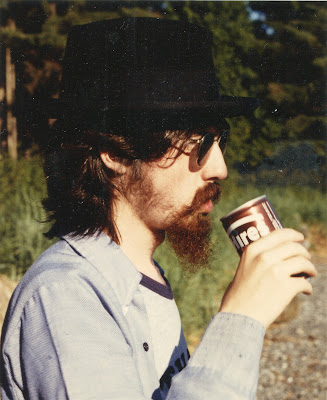
Your blogger in 1981, drinking ire

At the University I was occasionally pulled into other ensembles. I sang in a chamber chorus for a graduate student's choral music recital (fun!), pounded piano for a singer who was learning a fellow composition student's single-character opera (The Tell Tale Heart), and played piano in various UW Contemporary Group concerts. I tried unsuccessfully to learn Bizet's two-piano "Jeux d'enfant" with Christopher Mehrens for a class with Neal O'Doan, and finally signed up for the University Singers, as an easy ensemble credit. This led to my career on the opera stage, as illustrious as it was lengthy. The University was staging Dvořák's "Rusalka" and I was tagged for the chorus. I fit the bill perfectly: sack of meat, sang tenor (more or less). I was then bumped up to the "next level" chorus, where I remember singing in the first-tenor section in performances of Berlioz's "Requiem", Haydn's "Lord Nelson Mass", Beethoven's underrated "Mass in C Major", Walton's "Belshazzar's Feast" and Orff's "Carmina Burana". I even tried my hand at writing music for choir and organ. "Choral Set" (1981) consists of an Introit, an Anthem, a Prayer Response and an Extroit, none of them successful.

Aaron Keyt in the early 80s

I would also, when asked, play fellow students' piano compositions. We may have already become acquainted and started hanging out together by then, but it is in this context, in 1980, that I first worked with Aaron Keyt, who had started in the program a few years after me. I played his composition "Seven Piece Match Set" for the weekly seminar and for the Young Composers' Concert that November. We have been collaborating steadily ever since. Much more later.

Neal Meyer, with hair grown back

In my last quarter, Spring of 1981, I took part in the UW Contemporary Group Improvisation Ensemble under the guidance of Stuart Dempster. I was excited to join this group after hearing them perform the Spring before and realizing, much to my surprise, that I could follow what they were doing. It wasn't that hard. I could do that! It was in this group that I first worked with Neal Meyer (now Neal Kosály-Meyer). Of course I had seen him around the music building - he was hard to miss, a bearded young man with a shaved head (not a common look back then) lugging a synthesizer around in a big blue case. I would have been dumbfounded had you told me that in a few years I would marry his sister. Again, much more later.

Wednesday, January 12, 2022

KCBOL - 1980

 KCBOL

During one of our lessons Ken showed or described to me a single-panel cartoon in which five parking meters, each a different height, stood in a row in order of size but for one, which one had a sign hanging from it: "out of order". I believe that the subject of our discussion was the perceived relative specificity of orderings of notes and other structures in music. The image has stuck with me, but at the time it became a structural motif for "KCBOL: A Minimal Extravaganza For Two Pianists". 

I wrote five piano pieces, each of different heft, from the smallest with just two notes, to the largest with over 200 notes. I asked a fellow student, Andrew Buchman, to assist in the performance. The stage was set with a piano in the middle, and a small table and chair in the bend, facing the audience. We entered, wearing matching tee-shirts with "KCBOL" blazoned upon them. I took my seat at the piano and Andrew at the table. The "program notes" and script are the graphics herein. The last diagram is how the blocks would look to the audience, in the same "mis-ordering" as the letters in the word BLOCK in "KCBOL". I also used that ordering, and possibly variations of it, for many of the internal figures and melodic contours throughout.

Of particular interest to me, later, were the largest "K" piece and the smallest "B". At a background level, the pitch material of K explores the notes making up a minor seventh chord (B, D, F-sharp, A) in ways that were similar to the procedure used in my later Intermezzos 1, 2, 3, and 4, (1981-1982) and is also a "one note at-a-time piece as Intermezzos 1 and 2 almost are. B, with its two notes, is echoed later in the fifth of my 5 Movements (1983), which also consists of 2 notes.

Performances

March 4, 1981 - Meany Studio Theater, University of Washington, Seattle - Andrew Buchman, Keith Eisenbrey

Recordings

March 4, 1981 - Andrew Buchman, Keith Eisenbrey

June 29, 2009 - Keith Eisenbrey

July 29, 2009 - Keith Eisenbrey

blogposts

July 5, 2017

"As cockamamie as the scheme was, there are many features of this 1980 piano piece that continue to be of use to me. As originally conceived there is a theater bit that goes with it, involving stacking alphabet blocks and ringing finger cymbals (which idea came back as whacking an oil drum at the beginning of Five Movements as performed at Bard in 1984). The original performers were Andrew Buchman and me. The midmost movement of the five is a two-note piece for piano four-hands."


Wednesday, February 10, 2021

Ken Benshoof - 1980

Sonata for Violin and Piano "Bryd one Brere" (1980)

Habitabit (1980)

Sonata 1980 (1980)

From Fall of 1977 to Spring of 1980 at the University of Washington I studied composition with Ken Benshoof. These compositions are among the last ones I worked on with him. I was pretty headstrong, and it would be another several years before much of what he tried to teach me had any effect. He gave me some advice about playing piano that I still find valuable every day. "Tell the whole story every time." He was a kind and thoughtful teacher and I am deeply grateful, both for the support he gave me at the time, and for the many wonderful conversations we have had over the years since.

your blogger ca. 1980, with what passes for a smile

I was taken by the early 14th English Century melody "Bryd one Brere" when it came up in a class on medieval music, and used it as a starting point for the showy Sonata for Violin and Piano "Bryd one Brere". I was attempting to write an idiomatic virtuoso violin part so I tried some splashy effects, such as left hand pizzicatos and multi-string glissandos. The piano part features a bunch of hand and arm clusters. My heroic violinist, Aloysia Friedmann (since gone on to great things) rose to the occasion magnificently. It's no great piece by a stretch but it's fun and makes me smile.

One of the many benefits of a large school of music is that one gets to know some phenomenal young musicians, such as Aloysia. At some point I also got to know Sue Walsh, a coloratura soprano with perfect pitch who was up for something different. Habitabit is a setting, in the Vulgate Latin, of the Peacable Kingdom passage from Isaiah ("The wolf shall dwell with the lamb . . ."). In an attempt to throw a bunch of wolves and lambs together in a pile I used, among other things, a strident ostinato bass rhythm, quotation (a Schubert dance), and called for extensive improvisation both from the pianist and the singer. It was an honest attempt, but something of a train wreck in the end. Its best moment is a long stretch repeating a loud juicily dissonant chord over and over with the dampers up. Sue sang wonderfully.

your blogger drinking ire
Sonata (1980) is a bit of a freak flag fly piece. It quotes (I was really into quoting) Nielsen's "Fifth Symphony", Cole Porter's "Let's Misbehave", and the "Dies Irae"; throws in a some twelve-tone-ish passages, loads of vigorous clusters and graphically notated clouds of scattered notes; and imitates a little music box that's winding down. Each of these features interrupts the others frequently, and are themselves interrupted by variously measured silent moments. The most interesting idea though was to use two different ways of measuring time - by breath (notated with brackets) and by meter (notated the usual way). Each different time system interrupts the other system. There are long stretches of nearly nothing happening except for a minor third tremolo. When I played it the next spring on the student composers' concert somebody, apparently, had had enough and walked out. I must admit I was rather pleased.

Performances:

Sonata for Violin and Piano "Bryd one Brere"

May 15, 1980 Brechemin Auditorium, University of Washington School of Music, Seattle

Aloysia Friedmann, violin; Keith Eisenbrey, piano

also 

June 13, 1980 home recording 

Habitabit

November 24, 1980 Studio Theater, Meany Hall, University of Washington, Seattle

Sue Walsh, soprano; Keith Eisenbrey, piano

Sonata 1980

May 13, 1981 Studio Theater, Meany Hall, University of Washington, Seattle

February 7, 2004 Music at the Edge of Space, University Temple United Methodist Church, Seattle

May 14, 2009 home recording

June 6, 2009 Preludes in Seattle Part 3, Chapel Performance Space, Good Shepherd Center, Seattle

Blog Posts:

February 13, 2011 - Sonata 1980 - Keith Eisenbrey (the recording of February 7, 2004 - no further comment)

March 1, 2011 - Sonata 1980 (the recording of June 6, 2009)

My live performance of June 6, 2009. The various species of pauses and interruptions are more clearly distinguished here than in my other performances, and I managed to refrain from rushing as much as I usually do. The Chapel piano sounds good.

June 7, 2011 - Sonata for violin and piano "Bryd one Brere"

Aloysia was a classmate of mine at the UW back in mumbletymumble, and she graciously agreed to play this little violin & piano piece. She has since gone on to great things and a wonderful career, as we all knew she would. The title comes from a 13th century English song that had come up as an example in a music history class. At the time my compositional method was to throw as many techniques as I could think of at the page and see which ones stuck. Use of quotations was one of them. The result in this case is kind of rollicking and showy. Aloysia negotiates my occasionally violinistic writing with pizazz. I do my best to keep up.

June 19, 2011 - Sonata for violin and piano "Bryd one Brere" (the recording of May 15, 1980 - no further comment)

July 14, 2011 - Sonata 1980 (the recording of May 13, 1981)

My live recording from May of 1981, at the Meany Studio Theater. The tape deteriorated some before I could rip it, but you can still hear the door opening for the guy who walked out on me.

July 24, 2011 - Sonata 1980 (the recording of May 14, 2009)

My recent studio recording.

December 30, 2012 - Habitabit

My 1980 Latin setting of the Peacable Kingdom passage from Isaiah. I was a student at the UW at the time and composed by hurling conceptual ideas at score paper to see what they would do. In this case I used quotations (a Schubert Waltz, I think), abrupt jump cuts between disparate textures, and directed improvisation, among other things. The whole thing ends up pretty much a mess, but my intrepid and phenomenally pitch-perfect soprano soldiered on admirably.

Études d'exécution imminent (Preface), Another, J, Hail The Blest Morn - 2014

your blogger with pile of woodchips In 2014 I finished the first eight pieces of what I felt would be a significant project for me, but wh...