Showing posts with label Aaron Keyt. Show all posts

Tuesday, September 23, 2025

The Decade of Chaos Part 2: 1995-1998

your blogger and family visit Bickleton, WA
During the latter half of the decade of chaos I spent a lot of time working on a cantata - The Abyss (1998) (since withdrawn) - for small SATB chorus, with an orchestra of five wind players and string quartet. It is based on several stanzas from Byron's Childe Harold's Pilgrimage. Being flush with how well my first mod-17 piece - Psalm 130 (1994) - had come together I wanted to make something ambitious to see if it would work on a large scale. The resulting piece has some significant performance challenges, chief among them being ridiculously aspirational ranges for the singers. That aside I was struggling with what it meant for a music to actually be "in" mod-17, and not just some funky bespoke diatonicism. Although many parts may be quite effective from an expressionist standpoint, the whole is hopelessly wooly. But no work is wasted and I did accustom myself to thinking outside the mod-12 box. I also re-used some of the melodic ideas in other smaller pieces such as Two Pomes Play (1997) for clarinet and bassoon.

Neal and Karen in Bickleton, WA
In 1995 I arranged one of my fourpartsongs of 1992 - O Love, How Cheering is Thy Ray!- for solo voice and piano so that Karen could sing it for a church service. And for a while after that I was composing a song for that purpose every year or so, among which was Glory to God (1998), a setting of the first few stanzas of Charles Wesley's hymn, later stanzas of which appeared as the first hymn in the Methodist Hymnals of the last century as Oh For a Thousand Tongues To Sing.

Karen and I remained quite busy with our church choir through these years. We rehearsed in the choir's church-basement room, but would often work our way upstairs to the sanctuary to practice with the organ. Our organist, the fabulous David Di Fiore, usually got to the loft before the choir got themselves together, and would often accompany our straggling procession to the chancel with rousing quasi-calliope music. This amused me enormously so I wrote a piece for him, based on the hymn tune "Foundation" (popularly known as Come Thou Fount of Every Blessing) that, at one point goes into full calliope mode. I named it after one of my favorite lines in the hymn -  "Here I raise mine Ebenezer" - and being the clever lad I was I folded in an adaption of the hymn tune "Ebenezer" as a counterpoint. David played it magnificently and I treasure the recording I have of his performance.

In 1995 I gave another recital - Local Flavor - at our church. The program was:

Six Piano Pieces - Aaron Keyt
Short Forms - Ken Benshoof
Fifth Sonata - Lockrem Johnson
Oracle from Dark Wood - Neal Kosály-Meyer (with Neal joining me in a speaking role)
Sonata in 2 Movements - Keith Eisenbrey

your blogger with kids having a picnic
In August of 1996 we welcomed a second baby into the family, wisely deciding to stop right there. Besides our rapidly shrinking house, Karen made it quite clear that she now considered child birth to be a younger person's sport, and that she was done. In 1998 we travelled once again to Yellowstone, destroying the radiator in our car (a used Volvo with a turning radius to die for I had purchased from a co-worker). We met Karen's folks there, staying at a cabin at Canyon. Karen's sister, her husband David and their two kids also made it there, but Neal's little family were stymied by breakdowns and only got as far as Coeur D'Alene. 

your blogger in mid chaos
And Banned Rehearsal just kept right on making tapes. some highlights were two live performances - two 1996 sets at The Speakeasy Internet Café in the Belltown neighborhood of Seattle (a few months before a fire closed it down) and back at Brechemin Auditorium at the UW School of Music in 1997 for Banned Rehearsal 440. Shortly after that I bought a DAT recording device and we have been recording ourselves digitally ever since. We also put out our one and only CD - Teach Yourself to Drive (1998). It was a milestone for us, but definitely added some stress to the system on top of the general struggles of life with small children.

Banned Playout (1995):
Numbered: (380-409): 26:27:52
Peripherals: 15 Sessions: 07:31:01
Total 1995: 33:58:53

Banned Playout (1996):
Numbered: (410-439): 27:15:52
Sectionals: 1 Session: 00:46:05
Peripherals: 8 Sessions: 03:55:53
Total 1996: 31:57:50

Banned Playout (1997):
Numbered: (440-477): 34:49:45
Peripherals: 1 Session 00:25:58
Total 1997: 35:15:43

Banned Playout (1998):
Numbered: (478-517): 29:14:24
Sectionals: 1 Session: 00:28:01
Peripherals: 4 Sessions 02:06:54
Total 1998: 31:49:19

Grand Total: 613:58:22

Scores:

Two Pomes Play
O Love, How Cheering is Thy Ray!
Glory to God
"Here I raise mine Ebenezer"

Recordings:

O Love, How Cheering is Thy Ray!

"Here I raise mine Ebenezer" (performed on piano)

Wednesday, October 30, 2024

Return to Puget Sound - Summer 1984

your blogger working hard
Several things happened quickly upon my return to the Puget Sound area at the start of June 1984. I moved back into my parent's home and took a week off before seeking employment. One afternoon that week my brother Glen and I took his wooden rowing boat to the Arboretum and paddled around Foster Island. Coming around a bend we came upon a less than fully clad sunbather, who smiled charmingly as we tipped our hats and paddled on. Welcome home!

I figured that a relatively mindless office job would leave me free to do music the rest of the time. I went to an agency in downtown Bellevue, which sent me to interview as a typist at Ticor Title Insurance near the waterfront in Seattle. The supervisor mentioned that they were also looking for someone to fill a position as an "abstractor", which involved sorting through court filings for information relevant to the title industry and typing up abstracts in a species of typographical shorthand - "NWC" was "Northwest Corner", "NH SEQ NEQ" was 'North Half of the Southeast Quarter of the Northeast Quarter", etc. Short story made shorter, the super felt that if I could read music I could read legalese and I got the abstractor job. I worked for Ticor until the company was purchased by Chicago Title Insurance in 1991, and for Chicago until my retirement in 2021. I also picked up a coffee habit, largely by accident.

gluing down the sound board on the clavichord
On the musical front, I had met up again with Neal and Aaron and we decided it might be fun to try improvising on instruments we didn't know how to play for a few sessions. Unable to resist the pun once it arose we called ourselves Banned Rehearsal before we had even made our first tape, which occurred on June 24, the weekend after I started work.

I thought I might never be able to afford a place suitable for a piano so I decided to buy a build-your-own clavichord kit. I hadn't been at work long so my dad co-signed on a loan for $1600 and I was delivered of a box of boards, a full-sized schematic drawing, a thin book of instructions, and a sinking feeling that I had just wasted a wad of cash I didn't have yet. But thanks to my dad and some help from my brothers we got it finished a year later.

The Sprite
As the Banned Rehearsal project persisted odd little instruments began to amass. I commandeered my mom's guitar and autoharp, which had both been languishing unused for decades. On a whim I spent $200 on an old Wurlitzer Funmaker Sprite - a little electric organ with chord buttons, drum rhythms that could all be played at once (great function!) and another button that dropped the pitch down almost, but not quite, a half step. This first appeared (if I am not mistaken) on Banned Rehearsal 10 of September 23, 1984, and quickly became a mainstay of our sound for years to come.

It was also during those first few months that we devised a way of having our (by then) weekly sessions even when we weren't all in town. We would each make a tape wherever we were (called Banned Telepaths) and would then mix them together later (using multiple cassette decks, two-in-one-out mixer cables, and a cheap Realistik mixing device. Truly low budget and low fi, but the method has served us well over the years through geographic displacements and the recent pandemic. This equipment also enabled us to create what we called the Stack-O-Decks so that we could play several sound sources at once into our session space (usually my bedroom) - another commonplace of our early sound. During one such telepath session Aaron picked up the guitar and came up with the first Sudden Song: Bickleton Burger.

It's rhythms, chords, and slide button
no pickles
no mustard
no ketchup
no buns
no meat 

it's a Bickleton Burger
Bickleton Burger
have 'em away
yes it's a Bickleton Burger
have 'em away 

no relish
no special sauce
no sesame seeds
no bacon
no cheese 

just a side-order of fries
on my Bickleton Burger
Bickleton Burger
Bickleton Burger
have it away
have it away

just a side-order of fries
on my Bickleton Burger
have it away

Tuesday, December 5, 2023

Living Among Others Part 1: Red Hook, Fall 1982 - Spring 1983

your blogger in his field
The School of Music at Bard, together with its various hangers-on, such as me, consisted of a small population scattered around a largely rural environment. Sessions of musical improvisation, being an essential part of the curriculum then at Bard, were also an integral part of us all just hanging out together. Between July of 1982 and June of 1983 I count dubs of 18 such sessions involving diverse groupings of Ben, Jill, Dan, Sarah Johnson (see below), Aaron Keyt (visiting from Princeton), and others, but that certainly wasn't all we did. Dan and I would often find ourselves in Jill's and Nancy's apartment, up several steep and narrow flights of stairs, tucked under the roof of "The Oaks", a large house located, more or less, between Red Hook to the East and Barrytown down by the Hudson River. Now my mom was not a bad cook (her pies were top-notch), but Jill and Nancy were resourceful and imaginative, and loved to cook for others. It was really with them that I first had an inkling of what cooking could be. The fare was largely vegetarian, since none of us had much money to buy meat. Some time that I year I also became acquainted with Sarah Johnson, an undergraduate with a lively mind and an engaging conversationalist who lived down by the river in the same boarding house (rumored to have once been a brothel) as Charles Stein.

Jill Borner and Bruce Huber
For amusement various subsets of us would be off to the movies, in Rhinebeck or across the bridge in Kingston, or to breakfast at one of several nearby diners, and once even as far down south as Poughkeepsie to see a concert. Jill was kind enough to invite me to her family's Thanksgiving dinner in West Hurley, which was exactly what one would expect of a mid-20th Century small-town family gathering: the menfolk watched football and the women cooked. The pies were to die for. Since I was visiting from what must have seemed to be Mars, I'm sure they thought I had an accent.

Nancy Chase, at The Oaks
At some point that Winter I decided I was finished being a tee-totaller and I relied on Jill and Nancy to decide what my first alcoholic beverage ought to be. They decided on a Guinness, and so it was off to a dark bar in Rhinebeck, tended by an acquaintance of theirs, wherein I valiantly sipped through about half before giving up and letting Nancy finish it. Bruce's local band, "The Trolls", put out a single that year, and that counts as the first 45" vinyl record I ever owned. The cover was hand decorated by Jill, and Nancy was one of the "Oobah" singers on the flip side. They were also the first rock band I ever saw at a dive bar, of which there were two such establishments close to the college. One was known colloquially as "down the road" and the other wasn't. It was also by virtue of a mixtape that a friend of Nancy's had made for her (known forever after as Nancy's Mix) that I first became acquainted with any 80s bands at all - REM, Bow Wow Wow, Flipper, The Dictators, U2, et cetera.

For Spring Break Dan invited us to stay at his family's beach-house in Ship's Bottom, New Jersey, on the shore between Asbury Park to the north and Atlantic City to the south. I promptly burned myself to a crisp, but had a wonderful time. Memorable was a flash flirtation with an adorable redhead emerging from the waves, a side-trip to a nearby wild-life preserve (Edwin B. Forsythe National Wildlife Refuge?) to dance with the birds and sand (but sans redhead, who seems to have vanished as suddenly as she had appeared), and collecting sculpturally broken seashells with Sarah. I'm afraid Dan's family, some of whom were also there, were somewhat puzzled and possibly alarmed to find Dan hanging with a bunch of what must have appeared to be latter-day hippies. I had grown my hair out and would occasionally garner passing cat-calls, the most common being "Hey Charlie Manson!" The whole thing mystified me.

Tuesday, December 27, 2022

After and Before 1981-1982

Book of Windows

Seven Strays

After graduation from the UW in the Spring of 1981, and before my pilgrimage to the East coast in June 1982, I worked part-time selling men's jeans at a department store at Northgate Mall, a job I got thanks to church connections. At the end of Summer I got a full-time job in the mail room at the home office of a cookware sales company in Bellevue.

your blogger in 1981 at home with a beanbag frog
I wrote several short solo piano pieces, none of them ever intended to be included in a set of anything, just quick sketches made when I happened to have a figurational idea I felt like working out. I bundled these together many years later as Seven Strays. I've performed a few of them on occasion, and even transcribed one of them for bell-choir the year I was directing one at our church in the late 80s. Being quasi-tonal for the most part, they can be made to seem intelligible and even attractive to those that might not go for the crazier stuff.

But most of my individual creative time was spent on a massive score-making project called Book of Windows. It involves a lengthy list of words derived from various sources, all arranged carefully using a system focusing on syllable count, line count, and a global multiplex acrostic in which the first letters of several equal subdivisions of line groups form sequences of words that are like unto lines within the greater text. In the final such subdivision, which divides the whole into three parts, the first letter of each respective segment spells the word ART. Very clever.

your blogger spinning vinyl and inking Book of Windows
In the final score the text unfolds on the left of each set of facing pages, and on the right-facing pages two sequences of notes spool out. The most extensive of these is written for piano and consists of carefully charted quantities of notes, lengths of passages as measured in quarter notes, vertical density, and number of times each segment is to be repeated. The other sequence of notes is a line of single pitches, intended for saxophone. I developed intricate charts to determine all sorts of aspects of how it would fit together. I added inscriptions (Gertrude Stein and Wilhelm Müller) and a preface to get it going, and finished it up with a chorale for the instruments.

I didn't want to specify how a performance of it might be accomplished, but it was given a table-read just before I left for Bard, with me on piano, Aaron reading the text, and my brother Paul playing clarinet. I think Neal was turning pages and helping to keep track of the whole mess. In 2005 I realized a midi-enabled version that clocks in at about 32 minutes. It was performed in public, for the one and only time, in a common space outside the cafeteria at Bard that Summer, with me playing Crumar, the inimitable Jill Borner reciting, and Bruce Huber transforming the sax part on electric guitar. As luck would have it another member of what has become my virtual colloquium of senior colleagues, Elaine Barkin, was visiting for a few days and suffered through the whole two-plus-hour ordeal. At the end, or so I was told, she pointed to my date-and-place mark in the score "Bellevue, 1982" and silently inquired of Ben whether I was really from the mental hospital. Ben, of course, just nodded in affirmation. "Bellevue, yes".

your blogger (in glasses), Neal Meyer (in t-shirt),
and Aaron Keyt (in jeans)
In the end it constitutes my one and only extensive experimentation with that oh-so-chic American stylistic juggernaut, Minimalism. When I was done I figured that I could thenceforward ignore the whole movement, having written something far more repetitive and ugly than anyone else would ever care to. Considering it now I can't think it's Minimalist in any essential way and isn't particularly brilliant as commentary either. Its worth, within my personal creative history, is as a compositional exercise in working with algorithmically derived structures.

Seven Strays - recorded February 10 and 11, 2010


Book of Windows - digital version realized March 20, 2005

Wednesday, December 14, 2022

From Stuart Dempster to Dave's Basement 1981-1982

your blogger with employment worthy haircut ca. 1981
During my last quarter at the UW I was a member of the University of Washington Contemporary Group Improvisation Ensemble, led that quarter by Seattle's legendary musical provacateur Stuart Dempster. I had been improvising on my own for years by then as part of my piano studies and later on of my compositional process, so I was comfortable with the concept, but this was my first experience doing so in a group setting. The focus was, crucially, on listening to each other, and less crucially for my later practice, listening for the endings of things so as to make satisfying pieces of music.

This was also my first opportunity to work together with Neal Meyer, who was also a member. We met in a large rehearsal space in the upper somewheres of Meany Hall and took advantage of the various percussion instruments and pianos in residence there. At the end of the year we played several such pieces as part of Neal's piano recital: Manhasset, Music With or Without 12 Chairs, Undifferentiated Functions, and Ein Hundenleben. After the term was over a group of us put together a free-range show at The Seattle Concert Theater, a former church building in the Denny Regrade, long since demolished. Several of us played solos, including my Seventeen Prepuntal Contraludes, and members of the Improv Ensemble did a couple of improvisations: Son of Manhasset and Well I Just Might Do That, in the latter of which Neal blew shaving cream into my ear through a PVC didgeridoo. Thanks. 

Aaron Keyt with others in Dave's Basement 1981
A few remnants of this crew, Dave Jones, Neal, Aaron Keyt, and me, would meet over the next months at various locations around town, centered on the basement of the house where Dave was living a few miles North of campus and not far from where I now live, to improvise together, often beginning with a warm-up activity courtesy of Pauline Oliveros' Teach Yourself To Fly. It was during this time that we became less fastidious about finding endings for things, though we still revolved loosely around the idea of making pieces. Most of the sounds from those days, though recorded at the time, have vanished, but what is left, notably our 3 Act opera Eliza, peripherating upon Kurt Vonnegut's novel Slapstick, is convincing evidence that the greater culture won't miss any of it much at all. 

your blogger displaying his unmistakable fashion sense
It was during this time that Aaron, Neal, and I began in earnest what has become now a lifetime of lobbing ideas back and forth, becoming as close to a band of brothers as can be got - including, eventually, in a literal sense, when, in 1986 I married Neal's kid sister Karen, who, as chance would have it, had been there at Neal's recital and thus in the same room I was in for the first time. Her first glimpse of me was of a long-haired dude coming out of the piano closet at Brechemin with a gavel in his hand. Meet weird. We were not introduced.


Post settings Labels Stuart Dempster,University of Washington Contemporary Group Improvisation Ensemble,Neal Meyer,Aaron Keyt,Dave Jones,Seattle Concert Theater, No matching suggestions Published on 12/14/22 11:36 AM Permalink Location Options Loaded more posts.Post: Edit

Tuesday, February 8, 2022

Playing with Others (part 2) 1977 - 1981

 Choral Set (1981)

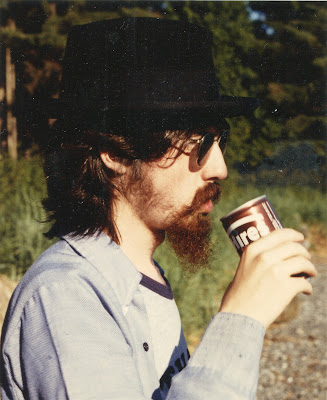
Your blogger in 1981, drinking ire

At the University I was occasionally pulled into other ensembles. I sang in a chamber chorus for a graduate student's choral music recital (fun!), pounded piano for a singer who was learning a fellow composition student's single-character opera (The Tell Tale Heart), and played piano in various UW Contemporary Group concerts. I tried unsuccessfully to learn Bizet's two-piano "Jeux d'enfant" with Christopher Mehrens for a class with Neal O'Doan, and finally signed up for the University Singers, as an easy ensemble credit. This led to my career on the opera stage, as illustrious as it was lengthy. The University was staging Dvořák's "Rusalka" and I was tagged for the chorus. I fit the bill perfectly: sack of meat, sang tenor (more or less). I was then bumped up to the "next level" chorus, where I remember singing in the first-tenor section in performances of Berlioz's "Requiem", Haydn's "Lord Nelson Mass", Beethoven's underrated "Mass in C Major", Walton's "Belshazzar's Feast" and Orff's "Carmina Burana". I even tried my hand at writing music for choir and organ. "Choral Set" (1981) consists of an Introit, an Anthem, a Prayer Response and an Extroit, none of them successful.

Aaron Keyt in the early 80s

I would also, when asked, play fellow students' piano compositions. We may have already become acquainted and started hanging out together by then, but it is in this context, in 1980, that I first worked with Aaron Keyt, who had started in the program a few years after me. I played his composition "Seven Piece Match Set" for the weekly seminar and for the Young Composers' Concert that November. We have been collaborating steadily ever since. Much more later.

Neal Meyer, with hair grown back

In my last quarter, Spring of 1981, I took part in the UW Contemporary Group Improvisation Ensemble under the guidance of Stuart Dempster. I was excited to join this group after hearing them perform the Spring before and realizing, much to my surprise, that I could follow what they were doing. It wasn't that hard. I could do that! It was in this group that I first worked with Neal Meyer (now Neal Kosály-Meyer). Of course I had seen him around the music building - he was hard to miss, a bearded young man with a shaved head (not a common look back then) lugging a synthesizer around in a big blue case. I would have been dumbfounded had you told me that in a few years I would marry his sister. Again, much more later.

Études d'exécution imminent (Preface), Another, J, Hail The Blest Morn - 2014

your blogger with pile of woodchips In 2014 I finished the first eight pieces of what I felt would be a significant project for me, but wh...